What is available and how are founders identified?
The Data City’s platform can analyse the leaders and founders of a company. Leaders are the active directors (officers) listed on Companies House. We place every company in one of six mutually-exclusive gender categories based on its active directors and, separately, on its founders (see below). We identify founders by looking at directors appointed within 2 years and 28 days of a company’s incorporation. We add a 28-day buffer to account for standard administrative reporting delays permitted under UK corporate law. Specifically, the Companies House “14+14” rule grants a company up to 14 days to update its internal register of People with Significant Control (PSC) following an appointment, and an additional 14 days to formally submit this information to the public register. Founders are specifically a person with significant control and they are still an active director at the company. A person of significant control is defined by Government. In short it means a person likely has voting rights, shares, or a controlling influence in a company. Companies are required to declare persons of significant control. It is possible to have information protected, however.How we categorise leadership and founders
Gender is assigned from each officer’s Companies House title (e.g. Mr, Mrs). Titles without a gender (e.g. Dr, Prof) count as unknown and are still included in the total. The Data City does not use machine learning, and never uses names, to estimate gender. Each company is placed in exactly one of six categories, based on the share of active directors with a female-gendered title (X) or a male-gendered title (Y):
The percentages are rounded for display; the boundaries are applied as exact thirds, so there is no rounding drift. A clear majority (more than two-thirds, but not all) is only possible on a team of four or more, so most companies fall into All, Mixed or Uncertain rather than a Majority category.
The same six categories are applied separately to a company’s founders (using the share of founders with each title).
Because the categories are mutually exclusive, every company sits in exactly one, so you can aggregate them safely (for example, “women-led businesses are X% of companies”). A company is women led when it is All women led or Majority women led, i.e. more than two-thirds of its active directors have a female-gendered title.
Where is the data?
ANALYSE
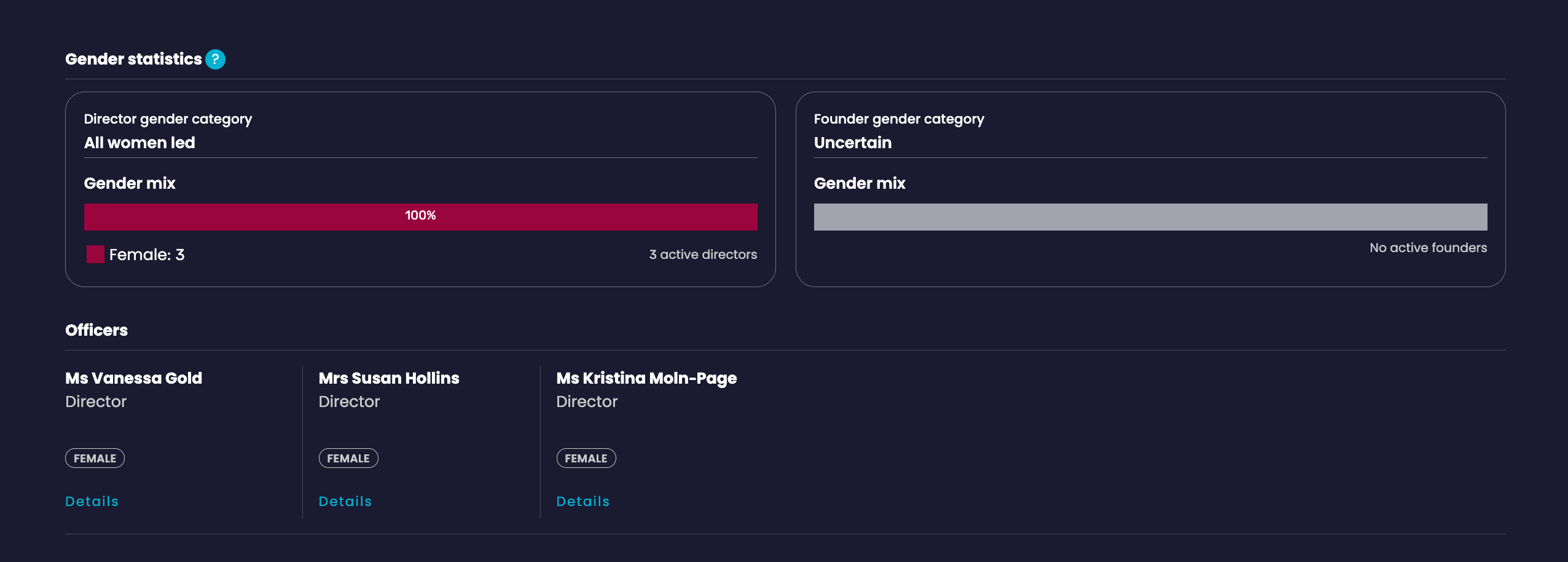
In ANALYSE, you can find gender data in the analysis summary box and in the company details panel. In the company details panel, the Gender section shows two 100% stacked bars (the founder gender mix and the director gender mix), each split into the six categories above. This communicates the proportion of companies in your list that are women led, men led, mixed, or uncertain, for both founders and directors.EXPLORE
In EXPLORE, you can find gender data in the people tab of each company page, under the Woman led statistics header. This includes the women founder and women officer counts, whether the company is women led, and the company’s director and founder gender categories.Filtering
In ANALYSE and EXPLORE you can filter companies by any of the six categories, separately for directors (leaders) and for founders. Ticking more than one category in a group returns companies in any of them. These options are available under the company filter.Appendix one: ANN SUMMERS LTD. (01034349)
As per Ann Summers’ website:10th December 1971, the first Ann Summers shop opened in Marble Arch. Their Executive Chair, Jacqueline Gold, joins her dad’s business as an intern with a brilliant idea - Tupperware parties, but for Ann Summers Product. The Ann Summers party is born.On Companies House, their incorporation date is 10 December 1971. However, on Companies House, their earliest officer (director) is David Gold who was appointed “before 1991”:
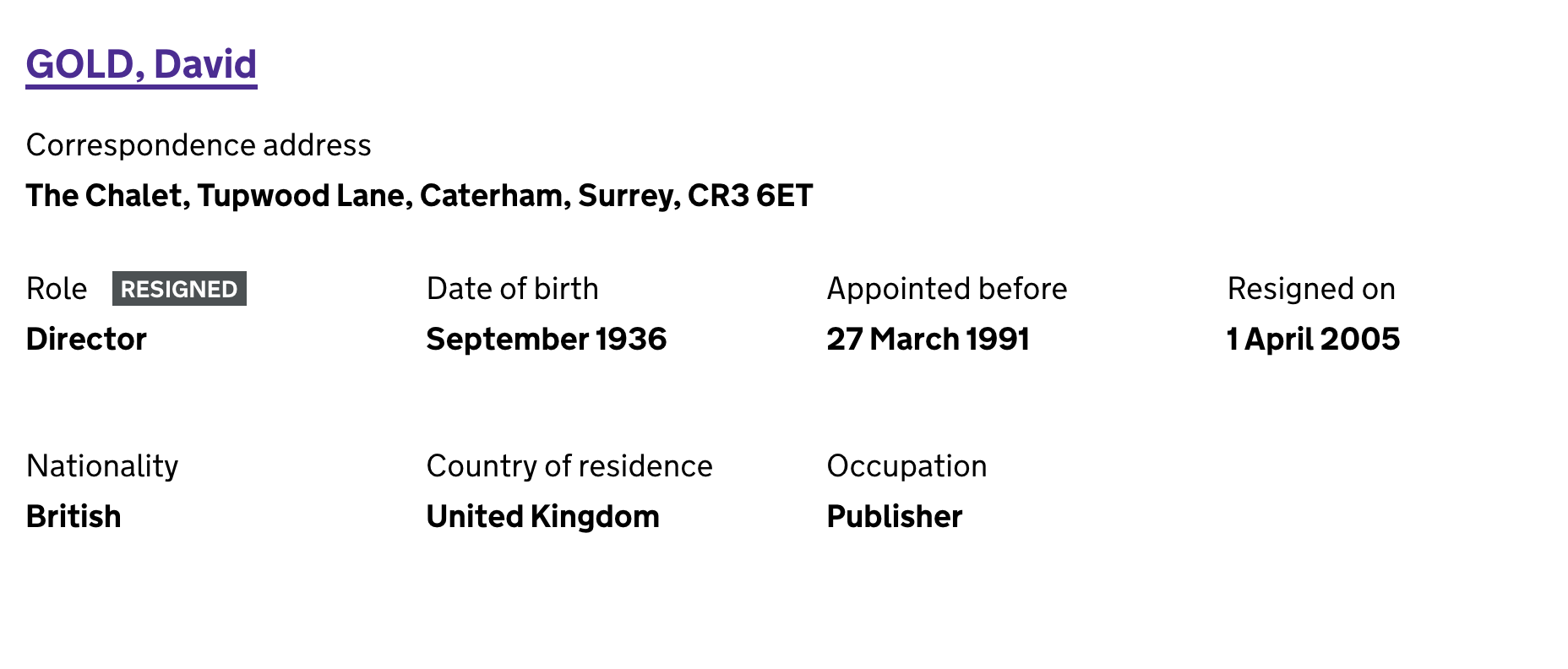
- We do not know the exact year David was appointed as a director.
- The incorporation date is 20 years before the director appointment date.