

Our data: Keen to find out more about our data? Make sure you check out our full list of data guides and knowledge base articles.
Method for matching
This uses the same general company-matching approach we apply across our third-party data. See Third-party data matching. We take all UK companies we have matched to a website on Companies House and all of Lightcast’s companies then we create a shortlist of Lightcast possible matches to TDC companies using a combination of different fields. We score the shortlist based on similarity metrics and add some sensible restraints. The highest scored matched is assigned the match subject to the match score exceeding a threshold. Our match rate is currently around 90% accurate. Due to issues with companies registering multiple entities of the same company, we may accidentally match one Lightcast company to many Companies House companies.Data
We extract specific datasets from Lightcast’s API which are most useful for analysis. We consider the most useful datasets to be: Jobs by Standard Occupational Classification (SOC4), Jobs by Lightcast Occupation Taxonomy (LOT), Specialised Skills, Common Skills and Certification Skills. The data is updated monthly and we take this data on a timeseries basis. Here’s how it looks on the platform: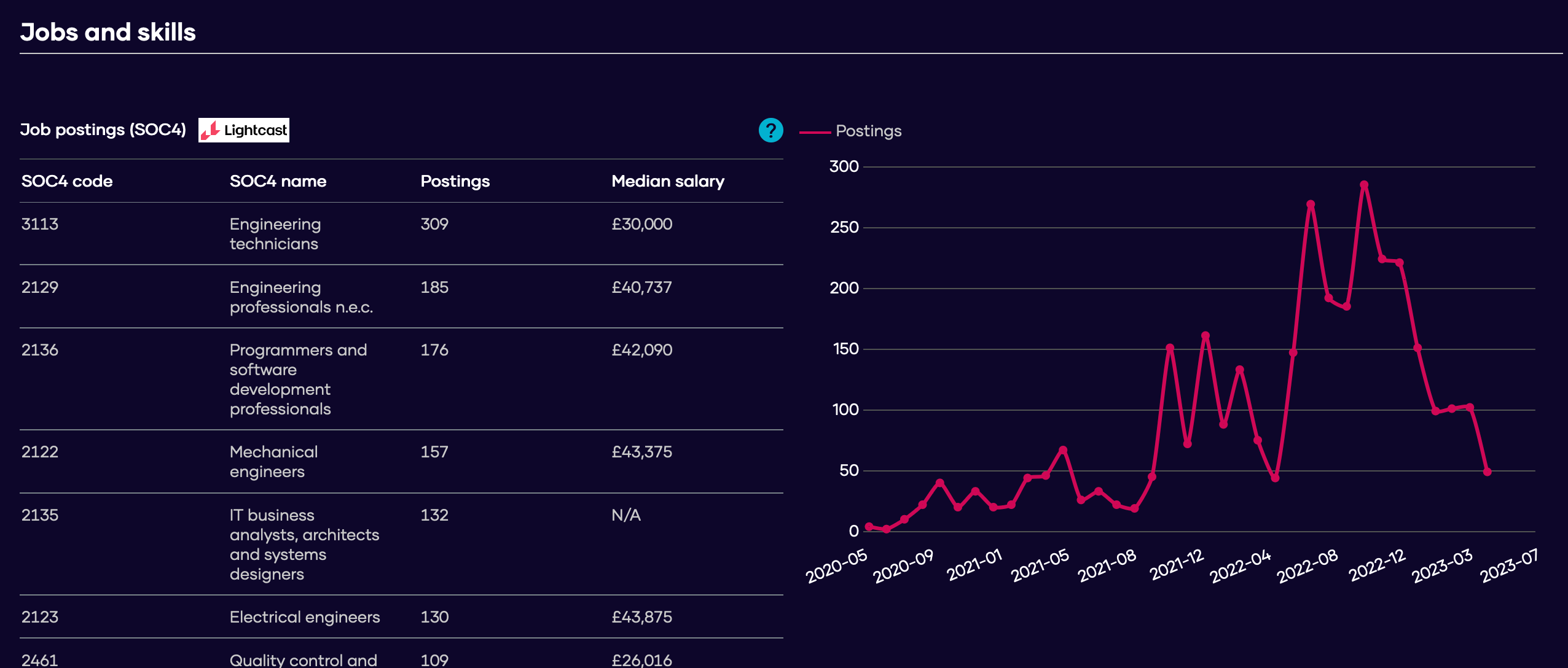
How we count job postings
New postings, not live vacancies
Every job postings figure is a count of unique new postings. We count each posting once, in the month Lightcast first recorded it as posted. A posting that stays open for several months still counts only in its first month. The figures don’t show how many vacancies were live (active) in each month. Because each posting appears in one month only, you can add monthly figures together. For example, add 12 consecutive months to get the number of new postings in a 12-month period. “Unique” means Lightcast has removed duplicate copies of the same advert, for example one job listed on several job boards.Time period covered
Job postings data covers a rolling five-year window. Each monthly update holds the postings from the five years before it. The same five-year window applies to totals that have no time dimension, such as postings by SOC4 code, by LOT code or by skill.Because the monthly update runs early in the month, the most recent month in a time series holds only a few days of postings. The earliest month is also incomplete. Leave both out when you compare months or add up a 12-month period.
Job postings over time in Industry Engine
ANALYSE shows job postings over time for each SOC4 and LOT code, and for all occupations together. See Jobs and Skills in ANALYSE. ANALYSE shows skills as totals for the five-year window, not over time. We do hold skills data by month. Contact support@thedatacity.com if you need it.Monthly data by occupation
Downloads and the API give each company’s monthly postings per SOC4 code inCompanyJobPostingsBySOC4CodeOverTime and per LOT code in CompanyJobPostingsByLOTCodeOverTime.
To build a time series for one occupation across a list, add up each month across the companies. One Lightcast company can match more than one company in our data, so check for double counting.