Removing subsidiaries can avoid double counting of employees and make your lists easier to view.
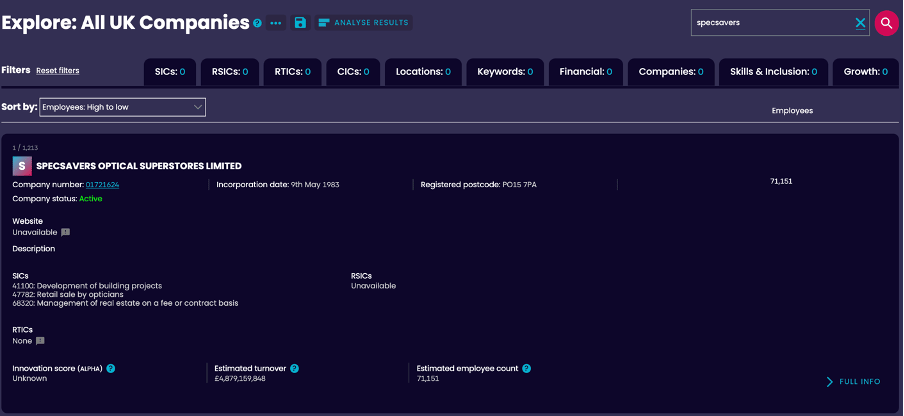
We remove subsidiaries from analyse and explore by default. You can choose to also look at all companies using the companies filter.Group structure is an area that we’ve been working on for a long time and with this release, we have included a feature that will simplify any lists you have created and improve your analysis.To show how this will be useful, let’s consider Specsavers. Specsavers has over 1000 companies in its group structure. The largest of these (by employee count) is shown below.The subsidiary companies of Specsavers often respond to a store’s location - many stores are incorporated as their own companies. Many of the subsidiaries of Specsavers Optical Superstores Limited have employees attributed to them. Importantly, these employees are also counted in the ultimate parent company, so there is the potential to double count employees.
A typical question that someone might answer in The Data City platform would be ‘how many people work in a given sector?’.It’s normal to take the list of companies and look at the number of employees associated with these companies. It annoys us a little to admit it is more complex than that. At the Data City we aim to simplify complexity wherever we can.One of the challenges that we’ve had for a long time is that companies can spread their operations over multiple corporate entities. This introduces the potential for double counting of financial variables, like employees or turnover.
How subsidiary accounts can include double counting
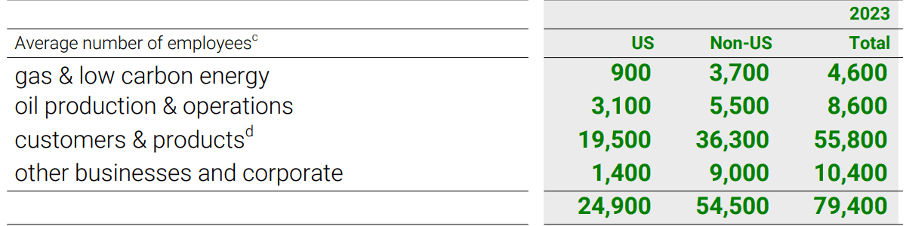
For the sake of simplicity, let’s answer the question of ‘how many people does a company employ?’. Let’s use BP.Is BP’s total employment the sum of its employees across all its operating companies? In short, it’s not.BP employed 79,400 people in 2023 according to the financial statements of the parent company. This is what is known as a consolidated statement. [1]BP has 194 UK-based corporate entities. If we sum across these entities, there are 87,600 employees. The extent of double counting by including subsidiaries will vary, depending on the number of entities, and whether they file subsidiary accounts. In this case, the double counting is around 10%.BP, as a large multinational, is a good example of the complexity of group structure. In total, there are 6 levels of corporate entities underneath the parent company. For example, the parent company has 23 children organisations. The 23 children organisations have 54 children of their own.As mentioned before, the parent company of BP filed a consolidated statement. A consolidated statement means that BP have gone through the work of removing double counting from across its group.“Where a parent company prepares Companies Act group accounts, all the subsidiary undertakings of the company must be included in the consolidation, subject to [the following] exceptions.”[2]
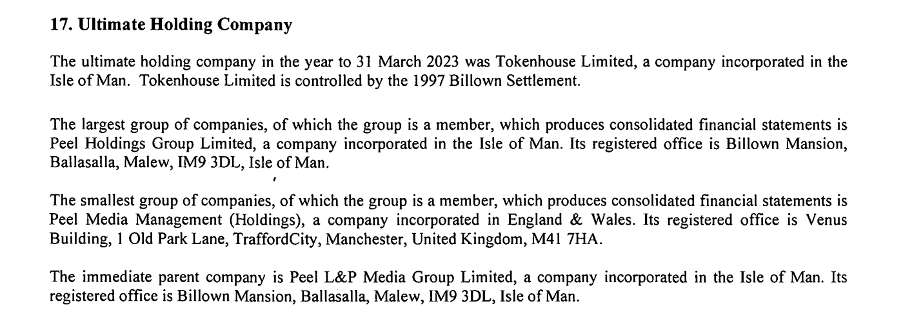
The purpose of this example is to provide a bit more information on what we mean by group structure. Specifically, this example will explain the difference between matched websites and group structure, as well as explaining the source of group structure data.A core part of our business is matching companies to websites. Matching to websites and scraping those sites allows us to classify companies into what they do.For some companies, we’ll match a large number of entities to one domain. Peel Group is a good example. There are 203 companies matched to the peel.co.uk domain.Does that mean these 203 companies belong to the same group? Unfortunately, no. There can be multiple groups within one domain. In this case there are 9 groups assigned to the peel.co.uk domain.The implication of this is that we won’t be able to ‘deduplicate’ down to one company per domain. There are further reasons why we won’t always be able to consolidate a list of grouped companies down to one company. Our priority is to simplify your analysis without introducing errors. We will, however, be able to consolidate a large number of companies.If matched websites and group structure are separate, what is the source of the group structure? Our group structure data comes from our data supplier Creditsafe.Creditsafe parse financial statements to gather group structure data. Below is an example of where you can find the raw group structure data. For example, Peel Media Management Limited although it is a group in itself, has an ultimate parent called Tokenhouse Limited. [3]
Why do you require a list to contain the parent AND the subsidiary to consolidate?
Let’s imagine that you are analysing a list of personal finance providers in the UK. You have built a machine learning list using known examples.When you review the machine learning list, you see that Tesco Bank has accurately been included in your list. Tesco Bank is a subsidiary of Tesco PLC. Tesco Bank reported 3,593 employees in 2023. Tesco PLC reported 225,659 in 2023.Tesco PLC has not been included in your personal finance list. They have a different domain (tesco.com vs tescobank.com). We should not consolidate Tesco Bank into Tesco PLC in this case because:
Tesco PLC was not identified using your filters
It would be inaccurate to include all of Tesco PLC’s employees.